

WHY THIS WINTER SOLSTICE IS DIFFERENT

Winter Solstice 2025:
The Winter Solstice isn’t only the “return of the light.” It is a Saturnian structural moment—one where orientation matters most.
In the Northern Hemisphere, the Winter Solstice occurs on December 21, 2025, this year, at approximately 3:03 pm London (UTC), when the Sun enters Capricorn and reaches its lowest declination in the sky. This marks the point of maximum darkness, where daylight has been reduced to its minimum before the gradual return begins. Solstice is an orientation point; through an astrological lens, it initiates Capricorn season—a cardinal sign (opposite Cancer’s Summer Solstice) and one of the four hinges or doorways that change our direction and relationship to light, consciousness, and time.
There is so much hype around Solstice—celebration, ritual—but in truth, it’s about containment: a pause before re-emergence or rebirth. Since the Autumn Equinox in Libra season (and this past Eclipse season beginning September 21, followed by the Mars–Mercury conjunction on October 19, then Mercury retrograde), we’ve been in a period of undoing—reckoning with consciousness, alignment, and how we strategize and take action.
Solstice doesn’t arrive as a solo event. You’ve been doing the work to get here—turning inward, shedding old layers. Some of us feel more alive in the process; others feel destabilized without light or assumed certainty.
Historically, solstice rituals were not oriented toward abundance or manifestation in the modern sense. They were concerned with continuity, containment, and social recalibration during the darkest point of the year.
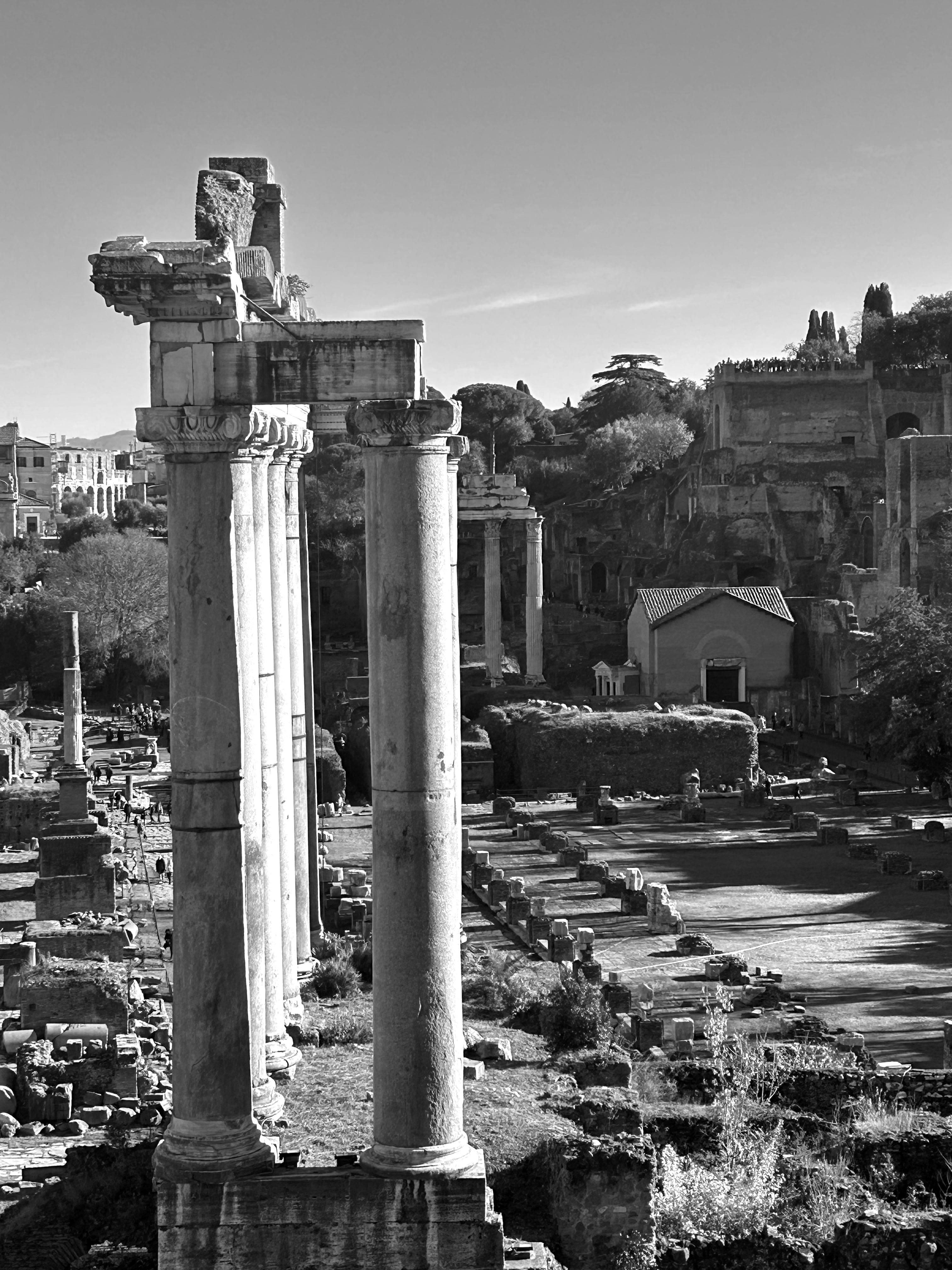
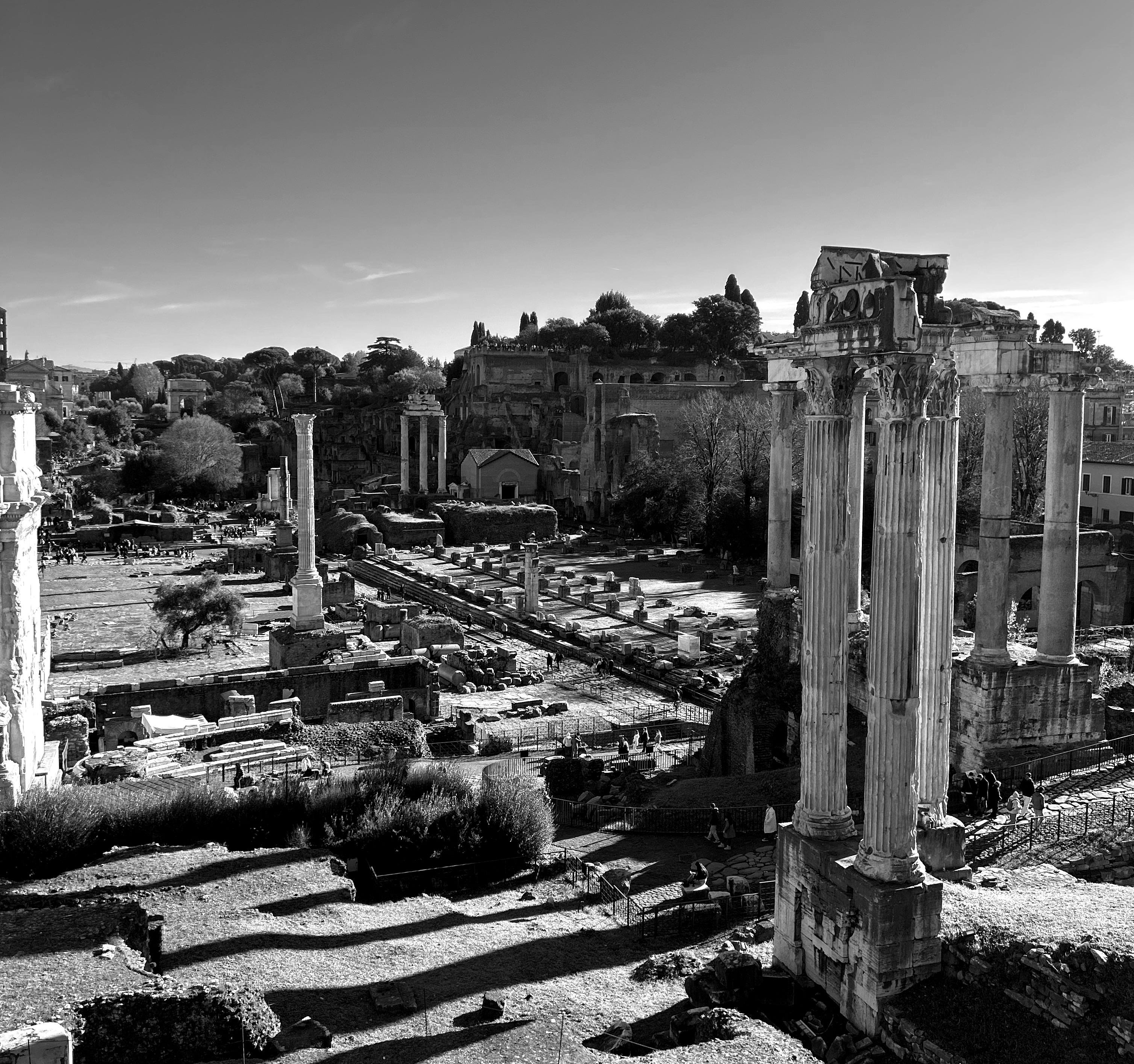
In ancient Rome, Saturnalia marked a temporary inversion of order before structure was restored. Held in honor of Saturn at the Temple of Saturn in the Roman Forum (pictured), the festival evoked the mythic Golden Age—a time when gods and humans were said to live in harmony. Social roles were reversed, work was suspended, gifts were exchanged (often modest objects such as sigillaria—small pottery or wax figures), and revelry was encouraged.
Yet this inversion was ritualized and time-bound. Its purpose was not excess for its own sake, but the release of pressure so that order could return renewed. Saturnalia did not dismantle structure, but strengthened it through contrast.
In much of pre-Christian Europe, the solstice was marked differently. Fires were kept low and steady rather than bright; the emphasis was on preservation, warmth, and survival rather than spectacle. In monastic traditions, silence, fasting, and restraint defined the season. The focus was not hope or expansion, but endurance.
Across cultures, the solstice functioned less as a celebration of abundance and more as an acknowledgment of limits: a collective pause that stabilized communities at the threshold of darkness, ensuring continuity until the light could return.
Capricorn season ushers us into this new architecture, not only as a precursor to the New Year, but as the quiet onset of light that will culminate at the Summer Solstice, Capricorn’s opposite (Cancer season), six months from now.
Capricorn as the Keeper of Time
As a cardinal, Saturn-ruled sign, Capricorn does not initiate the way Mars-ruled Aries does. It stabilizes what has survived and strips away excess to only what is necessary. Capricorn governs chronology, consequence, and the accumulation of effort over time. The Sun’s ingress into Capricorn marks the point where time becomes directional again—days lengthen, but only incrementally (and so do your strides).
This Solstice carries additional weight: Saturn, joined by Neptune in Pisces, is completing a 2.5-years cycle, giving this moment a stronger completion signature than previous years.
This matters profoundly in 2025.
We are closing a numerological Year 9—a year of completion, release, and reckoning. Year 9s demand discernment: what is finished versus what remains unresolved. Capricorn season acts as a bridge between closure and initiation, preparing the ground for 2026, a Year 1—a year that requires ownership, agency, and action.
Capricorn asks: What can you sustain?
What Is Actually Happening This Solstice
This Solstice is not about vision or goals for the future, but about taking inventory of what remains standing after a long cycle of dissolution. Neptune (a fifteen-year cycle) and Saturn (a two years and a half cycle) are nearing the end of Pisces. Uranus has completed its eight-year cycle through Taurus. Pluto is now fully in Aquarius. Your old terrain, habits, ways of being have been worked thoroughly.
What you’re building now is not from nothing, it’s a structure for an entirely new terrain and experience.
This Solstice is a quiet recalibration of internal authority where:
illusions lose energy
endurance becomes visible and felt
responsibility becomes clarifying and even inviting, rather than heavy
Rituals for the Last Month of 2025
For the final month:
Reduce input. Less information. Fewer commitments.
Review the year without judgment. Rather than dreaming up new manifesting goals, ask: What endured in 2025? What didn’t?
Strengthen one structure in your life—the Capricorn part of your chart and life, as well as the Pisces part: sleep, finances, boundaries, time.
Below is a Winter Solstice sign focus, written for your Rising signs, centered on strengthening one structure in your life as the Capricorn–Pisces sextile quietly closes a long cycle. This is a supportive potential that requires effort and conscious effort to use well.
