

The Mind, the Moon, and Memory


I first began thinking seriously about memory because of my grandmother, Billie–Jean Mohee, the only person I have ever known to survive a rattlesnake bite. Her father was a twin, and like her, born in Nashville Tennessee. At nineteen, she married my grandfather, who was twenty-two, after knowing him for only three months. They married on March 8, 1952—a marriage that lasted fifty-seven years, until death did them part.
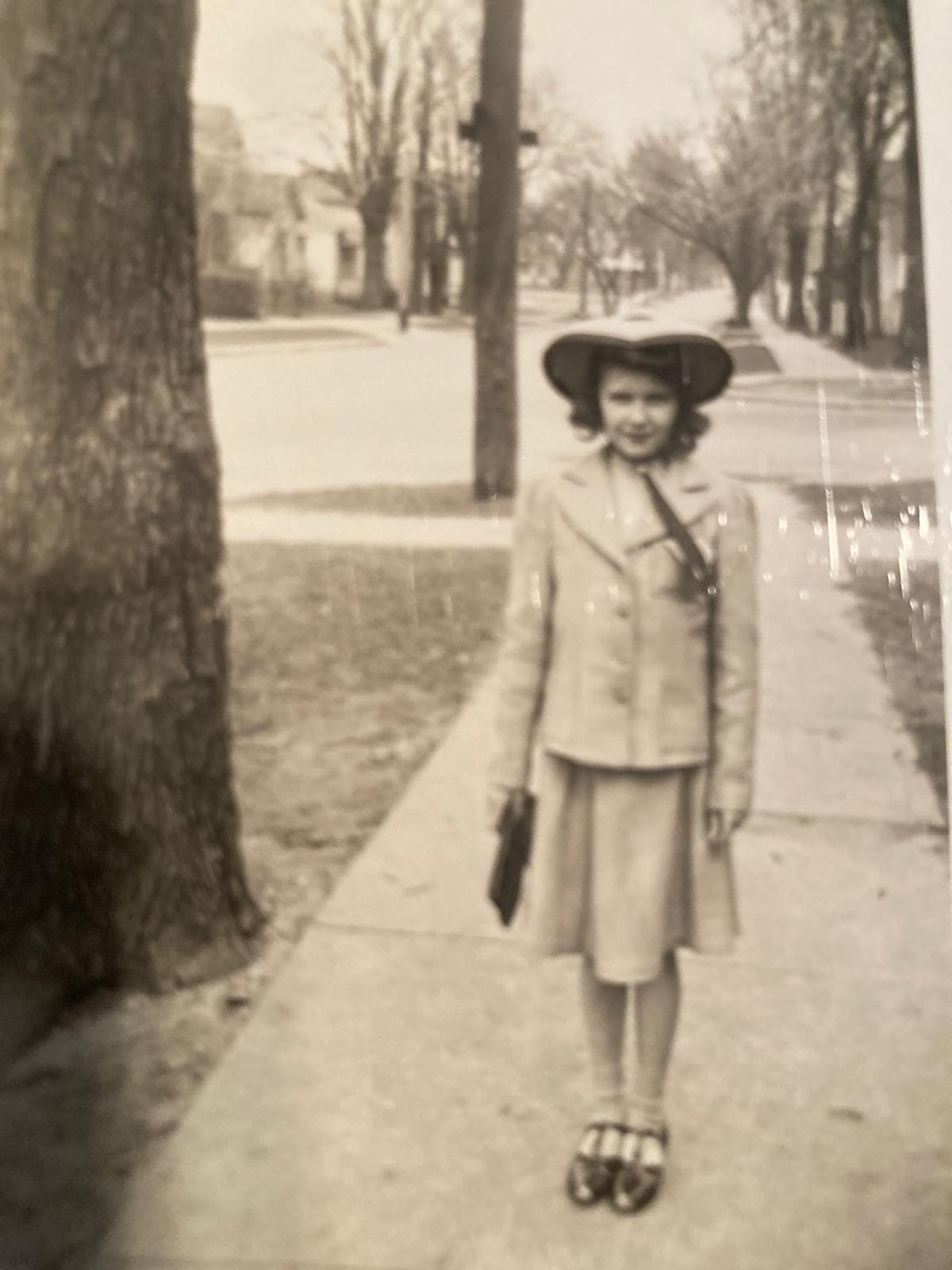
Billie-Jean.
My grandfather contracted polio at eight years old and spent a year recovering in a hospital while Pluto was transiting through his 12th house (the house of hospitals), isolated from his family and learning to navigate a body that never fully cooperated with him afterward. When he was finally released into the world, he had a little red Radio Flyer wagon, and his dog, Fluffy, would pull him through the neighborhood inside it.
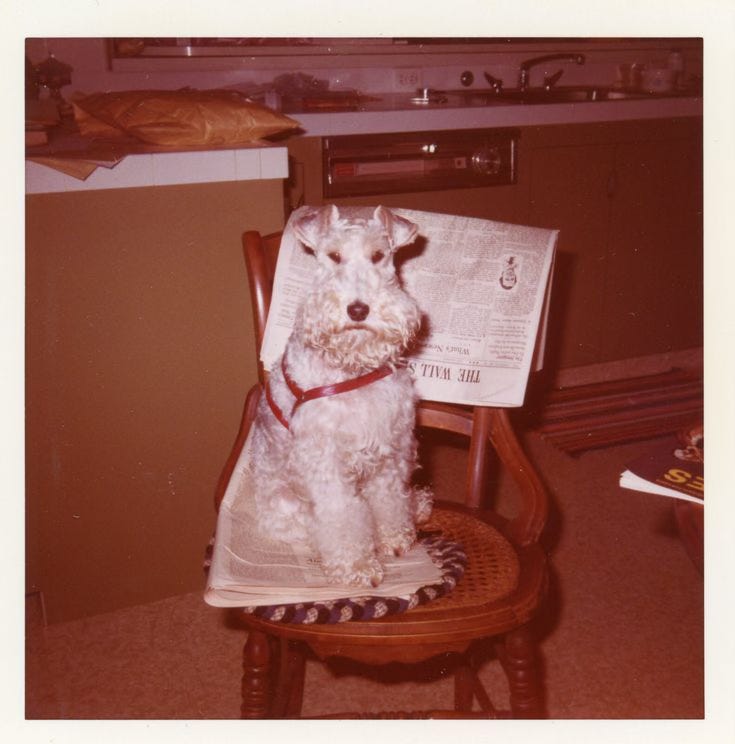
Fluffy, who’s not so fluffy.
Their love always felt mythic to me, almost impossibly devoted. Their story resembled The Notebook, though inverted in a painful way: he remembered every detail about her and, at times, behaved as though she were still herself, while she slowly lost the ability to remember him. Toward the end of her life, she would stare into empty spaces for long stretches of time. To her, those spaces seemed inhabited—dimensional, suspended somewhere between memory and vision, yet they called her constantly. I felt as though she were traveling beyond her body, her mind slipping into other dimensions.
My fascination with memory, intelligence, Mercury, and the Moon began there, around fourteen years old — a Saturn opposition, that strange age when reality first reveals the limits of time stretched out before you. It was the moment I really became aware of aging.
At the time, I had no real depth of understanding yet within the astrological framework for any of this. I only knew that being near her altered my understanding of what a mind actually was. Watching someone drift away from linear recall while remaining emotionally, psychically, and atmospherically present complicated everything I had been taught about intelligence. Somewhere along the way, we began confusing memorization with intelligence. The person who retrieves facts quickly, speaks fluidly, references efficiently, and answers immediately is often perceived as intellectually superior. These are profoundly Mercurial values: speed, articulation, categorization, analytical precision, rapid recall. Yet memory does not function mechanically, nor does the brain store experience like an archive. Neuroscience increasingly confirms that memory is sensory, emotional, spatial, and deeply tied to the body (The Moon). The mind reconstructs reality continuously through association, emotional salience, repetition, and perception.
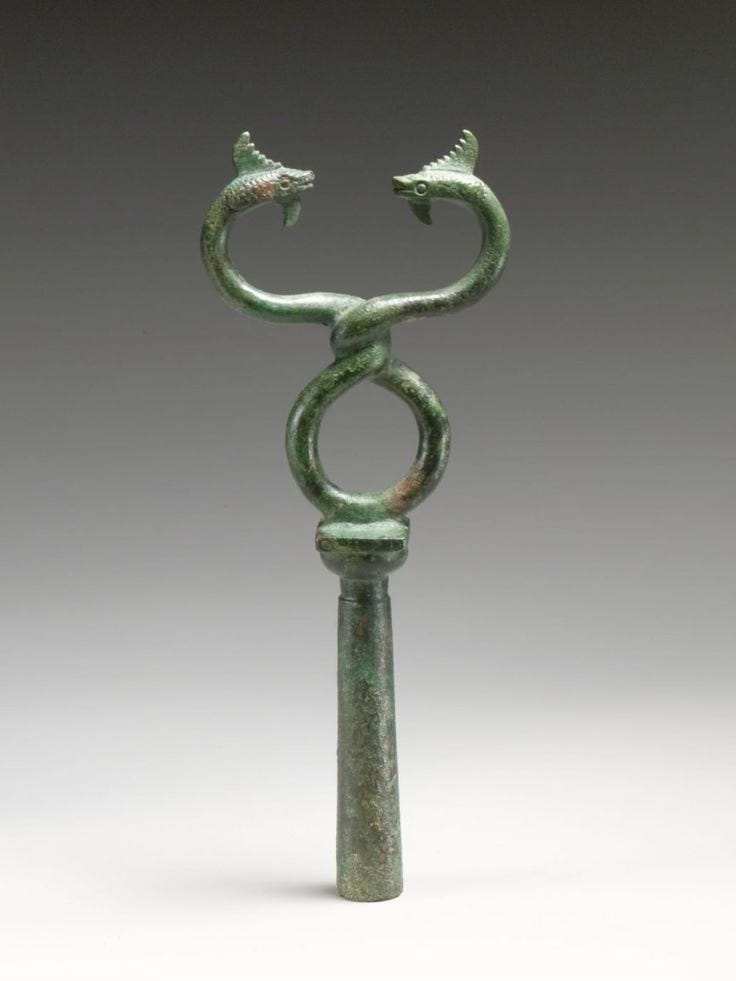
Le caducée d’Hermès. Greek kerykeion, 5th century B.C.
Looking back now, I cannot ignore how strangely Mercurial the symbolism surrounding her life feels. Snakes have long been associated with Mercury through the caduceus of Hermes: two serpents spiraling around a staff, representing healing, transmission, duality, synthesis, exchange, and movement between worlds. My grandmother was a nurse who wore a caduceus pin. Hermes was the messenger of the gods but also a psychopomp—a guide between dimensions, consciousness, language, but also silence—a role rarely emphasized in modern interpretations of Mercury. Even the detail of her father being a twin carries the symbolism of Mercury through Gemini, the sign associated with mirroring, doubling, parallel awareness, and the divided nature of perception.
Games as a Mercurial Quality
She also embodied many distinctly Mercurial habits. In retirement, she played crossword puzzles religiously, spent evenings absorbed in solitaire, and went on double dates to Las Vegas, where she and my grandfather gambled at poker tables deep into the night. She was rarely without an unfiltered Lucky Strike in hand or a cup of black coffee beside her. She loved Louis Armstrong, Roberta Flack, and Ella Fitzgerald; she loved jazz. Though her favorite was Led Zeppelin, Stairway to Heaven. Even now, whenever I hear those artists, I think of her stories about seeing them live—and the time Louis Armstrong smoked a joint right in front of her. Her mind was always moving, scanning, processing, and occupied. Near the end of her life she stopped smoking and drinking coffee, it almost felt as though something in her cognition dimmed alongside those rituals; as if the nervous system that had propelled her for decades slowly began releasing its grip on the world around her.
THE MOON
The Moon has represented many things across astrological traditions, though nearly all systems agree on one central idea: the Moon signifies the lived experience of being human. It governs memory, embodiment, emotional needs, habits, instinct, attachment style, rhythm, and the way consciousness is shaped through feeling and experience over time.
Whether the Moon represents the soul depends on the tradition.
In ancient Hellenistic astrology, the Moon was not typically understood as the immortal soul in the modern spiritual sense. That role was often associated with the Sun or higher spiritual principles connected to the daimon. The Moon instead represented the incarnated psyche: the changing, feeling, embodied self moving through the material world. It governed moods, memory, fertility, dreams, nourishment, the body’s rhythms, and the cyclical nature of earthly existence beneath the fixed stars. In many ways, the Hellenistic Moon resembles what psychology would later describe as the emotional unconscious.
In medieval and Renaissance astrology, the Moon remained tied to imagination, memory, receptivity, and emotional responsiveness. Because it constantly changes shape and visibility, it became associated with impressionability and reflection: the part of us altered by environment, attachment, and lived experience.
In Vedic astrology, or Jyotisha, the Moon is even more psychologically central. The Moon often represents the manas — the sensory and emotional mind. It governs emotional temperament, perception, memory, attachment, and the internal processing of experience. Many Vedic astrologers consider the Moon one of the most important indicators of consciousness as felt existence, because it reflects how reality is emotionally metabolized. A stable Moon like Taurus, steadies the mind and nervous system; an afflicted Moon like Capricorn or Moon conjoined Saturn, Moon in the 8th house, can create emotional turbulence regardless of intellectual brilliance.
Modern psychological astrology expanded this further, especially under the influence of depth psychology and thinkers like Carl Jung. Where, the Moon is associated with the unconscious, the inner child, ancestral inheritance, emotional conditioning, attachment patterns, and the psychic foundation through which a person experiences safety, intimacy, and belonging. Esoteric traditions and Evolutionary astrology associate the Moon with reincarnational memory and inherited emotional residue carried across generations.
The Moon is very charged in the chart; beyond your Moon, you have the lunar nodes (north and south in Tropical / rahu and katu in Vedic), and also Part of Fortune and Part of Spirit:

The Part of Fortune is lunar.
Not because its calculation is derived from the Moon in day charts, but because it describes the terrain of incarnation itself: the body, circumstance, inheritance, instinct, health, environment, fortune, emotional patterning, and the conditions one is born into and shaped by. Through the Moon’s lens, the Part of Fortune reveals where life is felt most viscerally. It is where the psyche absorbs experience almost unconsciously. It often describes what nourishes us, what destabilizes us, and where fate seems to operate through cycles outside rational control.
The Part of Fortune belongs to the realm of the Moon because it is tied to embodiment and continuity. It reflects the condition of being inside life — inside a family system, inside memory, inside emotional inheritance, inside a body moving through time. It carries ancestral origins. Part of Fortune is out of our control. Our lot in life. Much of it arrives through circumstance, timing, biology, lineage, environment, and emotional conditioning.

The Part of Spirit, by contrast, is Solar and Mercurial in quality.
It describes intentionality, direction, meaning-making, agency, vocation, consciousness, and the capacity to orient oneself toward purpose. Your Lot of Fortune reflects what life impresses upon the psyche, the hand you’re dealt. While your Lot of Spirit is the light within and the rationale mind, it’s how your choose to live, and the inner basis of every decision. It has to do with volition—the animating spark attempting to shape existence consciously rather than simply reacting to circumstance (Lot of Fortune).
Fortune is the emotional body,
Spirit is the directing intelligence.
Fortune describes incarnation,
Spirit describes participation.
Fortune says:
“This is the terrain you were given,”
Spirit asks:
“What will you do with it?”
Through the Moon’s lens specifically, this distinction becomes emotional and existential rather than purely conscious and logic. The Moon reveals how deeply the body and psyche absorb history, memory, attachment, and environment. Part or Lot of Fortune belongs to that absorptive process. Your Lot of Spirit emerges when consciousness begins relating to those inherited patterns intentionally.
The Moon mediates between them through memory.
Mercury
Mercury, by contrast, governs interpretation, and articulation of this process.
This is why the relationship between Mercury and the Moon is interconnected. Modern culture, we, tend to reward Mercurial intelligence: speed, articulation, categorization, rapid recall, analytical precision, verbal fluency. We often confuse memorization with intelligence because the person who retrieves facts quickly appears intellectually dominant. Yet, neuroscience increasingly suggests that neither memory nor intelligence are singular processes. Both emerge through multiple interacting systems tied to perception, emotion, association, embodiment, and cognition.
Researchers studying autism and neurodivergence, for instance, have observed that many autistic individuals process memory through heightened perceptual detail and nonlinear association. Some remember textures, sounds, emotional atmospheres, visual fragments, and sensory impressions with astonishing clarity while struggling with socially conventional forms of communication or retrieval. The nervous system prioritizes significance differently. What is emotionally or perceptually charged often remains vividly encoded long after factual sequencing dissolves.
Astrology has understood this symbolically long before neuroscience articulated it clinically.
Mercury categorizes, translates, narrates, analyzes, and exchanges. The Moon absorbs and retains. It remembers through atmosphere, repetition, sensation, emotional residue, rhythm, and bodily memory. Mercury may remember the facts of an event; the Moon remembers what the room felt like, the sounds, and light of that space.
Mercury describes the mind’s ability to process and retrieve.
The Moon describes what remains emotionally alive inside us.
Whenever I think about the Moon, I think about Billie-Jean, because some part of her continued perceiving long after language and articulation of her inner universe began unraveling. Toward the end of her life, names slipped away, timelines collapsed into one another, conversations wandered into puddled mumbling, and mannerisms into infancy. Yet she still recognized tenderness immediately. She still responded to tone, touch, emotional atmosphere. She still felt people.
Sitting beside her during her decline, changed my understanding of intelligence entirely. Modern culture, we, tend to reward and idealize the person who answers fastest, recalls facts most efficiently, speaks most fluently, organizes information most cleanly. Though, observing her for years as she phsyically and mentally declined, is a constant reminder that:
There are forms of knowing that survive articulation. A body still recognizing love, and a nervous system still responds to care.
Perhaps this is why the Moon has always been associated with memory astrologically, not because it remembers facts, but acts as a storehouse for dimensions we still don’t fully understand.
Which is also intelligence.
