

ECLIPSE AS OMEN

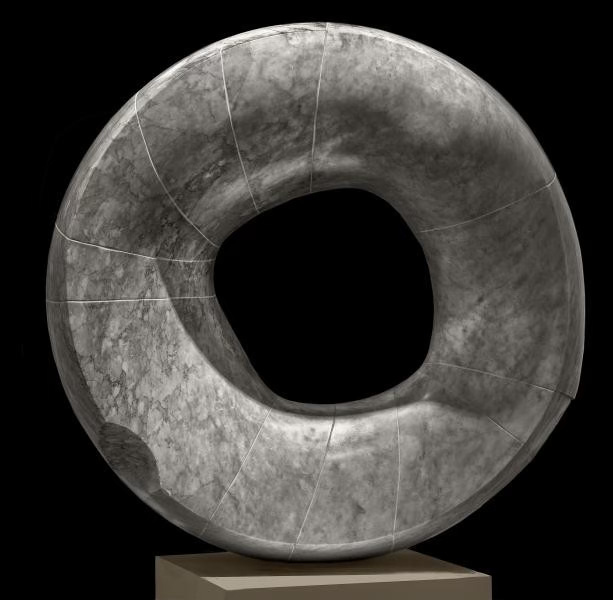
Grey Sun, a 1967 sculpture in bianco p marble by artist Isamu Noguchi
The Virgo Lunar Eclipse
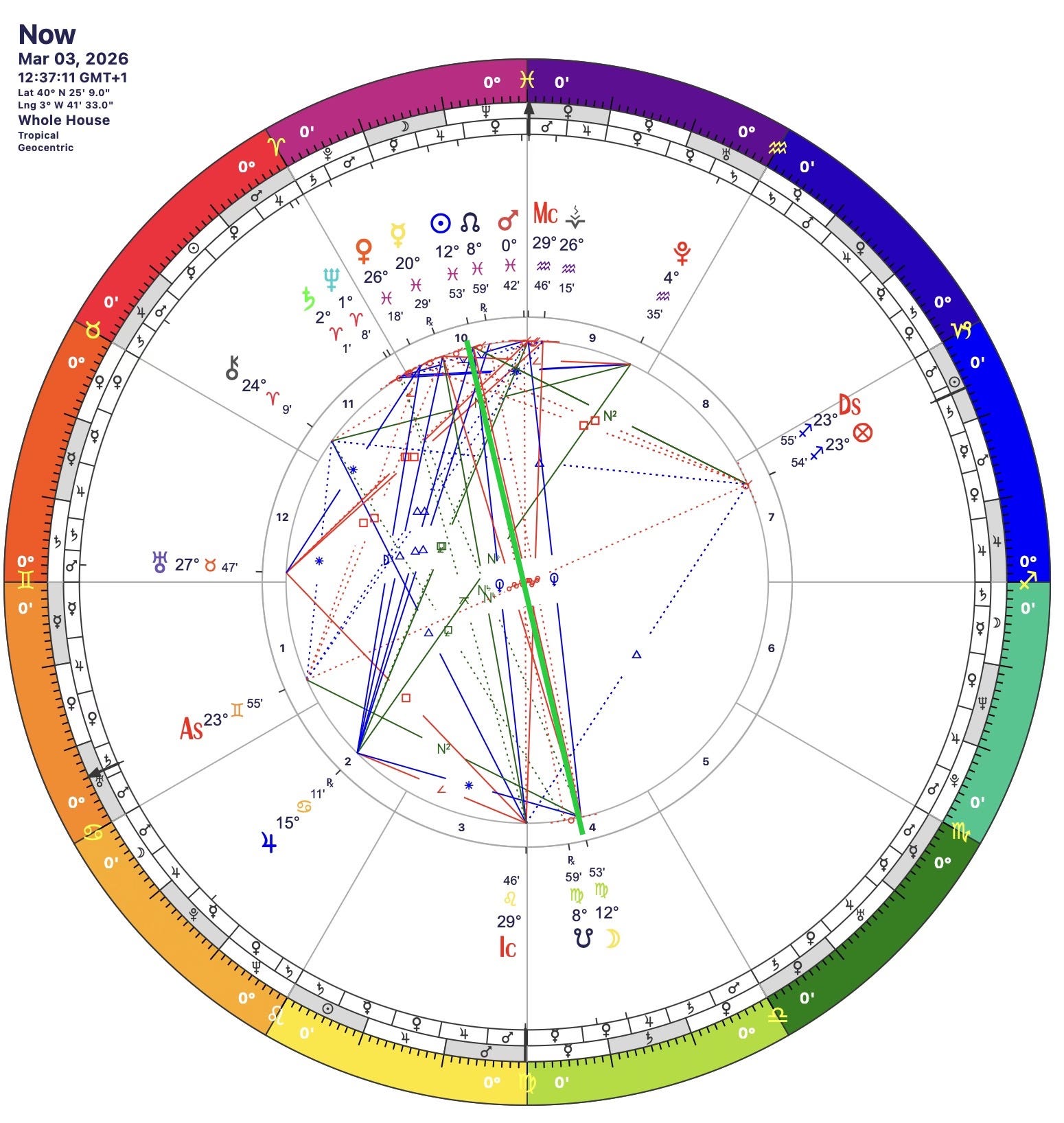
On March 3, 2026, the Moon eclipses in Virgo at 12°53,′ peaking at 6:33 a.m. EST and perfecting as a Full Moon at 6:37 a.m. EST. Astronomically, this is the ancient alignment: Sun, Earth, Moon—a syzygy, a straightening of bodies, where the Earth moves between the lights and the Moon enters shadow. This eclipse belongs to Lunar Saros 133, one of the great repeating eclipse families NASA tracks across centuries, with each member returning roughly every 18 years and 11 days, carrying a recognizable echo forward in time. (NASA Eclipse)
First: eclipses change the atmosphere, and not subtly.
You feel them before you’re able explain them, this one coincides with Mercury Rx.
The light (clarity around what’s seen and visible) distorts. Time feels equally distorted. The psyche becomes more permeable, and something hidden begins pressing toward visibility.
Eclipses always come in pairs (a Solar and a Lunar).
In tropical astrology, this lunar eclipse falls across the Virgo–Pisces axis: the Moon in Virgo opposing the Sun in Pisces, with the lunation drawn close to the lunar nodes, those invisible crossings where the Moon’s orbit intersects the ecliptic, forming magnetic, supercharged points in time. Note: on March 18, the next New Moon in Pisces, joined by Mars, will show more clearly how this eclipse is unfolding; until then, much of it is sensed before it can be named. This eclipse is shaped by Virgo discernment, Pisces surrender, and Jupiter in Cancer offering support—a sextile to the Moon, a trine to the Sun, and a softening influence within an otherwise fated sky. The ruler of Virgo, Mercury, is retrograde in Pisces, adding awareness through memory, revision, feeling, unfinished conversations, and the return of old material asking to be re-understood.
The ancient world did not treat eclipses casually.
In ancient Egypt, cosmic order was always sacred. Though, the planets held less importance than the fixed stars and the light cycles of the Sun and Moon. The regularity of the heavens was inseparable from meaning, rulership, agriculture, and ritual life. So when light was interrupted, it was no small matter. Surviving Egyptian evidence around eclipses is sparse, yet later omen traditions across the region approached them with gravity, viewing them as disruptions to the sacred order—moments charged with danger, reversal, or unrest. You can understand why. An eclipse does not look ordinary overhead; it looks ominous. In a culture shaped by Ma’at—truth, justice, and cosmic order—such a disruption in the heavens could feel like a brush with chaos. To name it was to risk strengthening and sanctioning its force. So there was silence: a refusal to speak it.
This is where I think modern astrology gets flattened.
People either dramatize eclipses into catastrophe, or they over-sanitize them into vague language about “change.” Neither captures their real potency.
Eclipses are pattern-breakers.
They interrupt continuity.
They expose what has ripened beyond maintenance.
They collapse a false timeline.
They accelerate what was already structurally underway.
A lunar eclipse is a culmination. A reckoning. A revelation through contrast. Something becomes visible because the light changes. In Virgo, that illumination often illuminates the reflective light through the body, work, systems, health, habits, organization, craft, care, and the conditions of your daily life. Virgo governs what is edited, refined, repaired, purified, ordered, and made useful.
It asks what is efficient, what is intelligent, what is sustainable, what is quietly draining life force through repetition.
Pisces, opposite Virgo, governs what cannot be managed or fixed by repetition: grief, faith, surrender, imagination, longing, the unconscious, spiritual fatigue, symbolic residue, collective feeling. So this eclipse is not simply about “getting organized.” It is about the living tension between control (Vigro) and trust (Pisces), between what can be improved and what must be released, between the part of you that edits life and the part of you that must let life move through you.
And eclipses repeat.
NASA tracks eclipse families through Saros cycles (an ancient architecture is at work: the Saros cycle, an eclipse family unfolding across roughly 1,262 years and repeating with astonishing precision), and because the geometry is exact enough to recur over long periods of time, repeating roughly 6,585.3 days (18 years 11 days 8 hours). Astrologically, we experience this as a storyline that returns: themes, people, emotional weather, decisions, and unfinished chapters—often around the same sign axis, the same place in your natal chart and life, often around similar degrees, with the feeling that an older chapter is resurfacing through the present.
This Virgo lunar eclipse carries a remarkable echo: March 3/4, 2007 (depending on location)—nearly the exact same day of the year, close to the same Virgo degree.
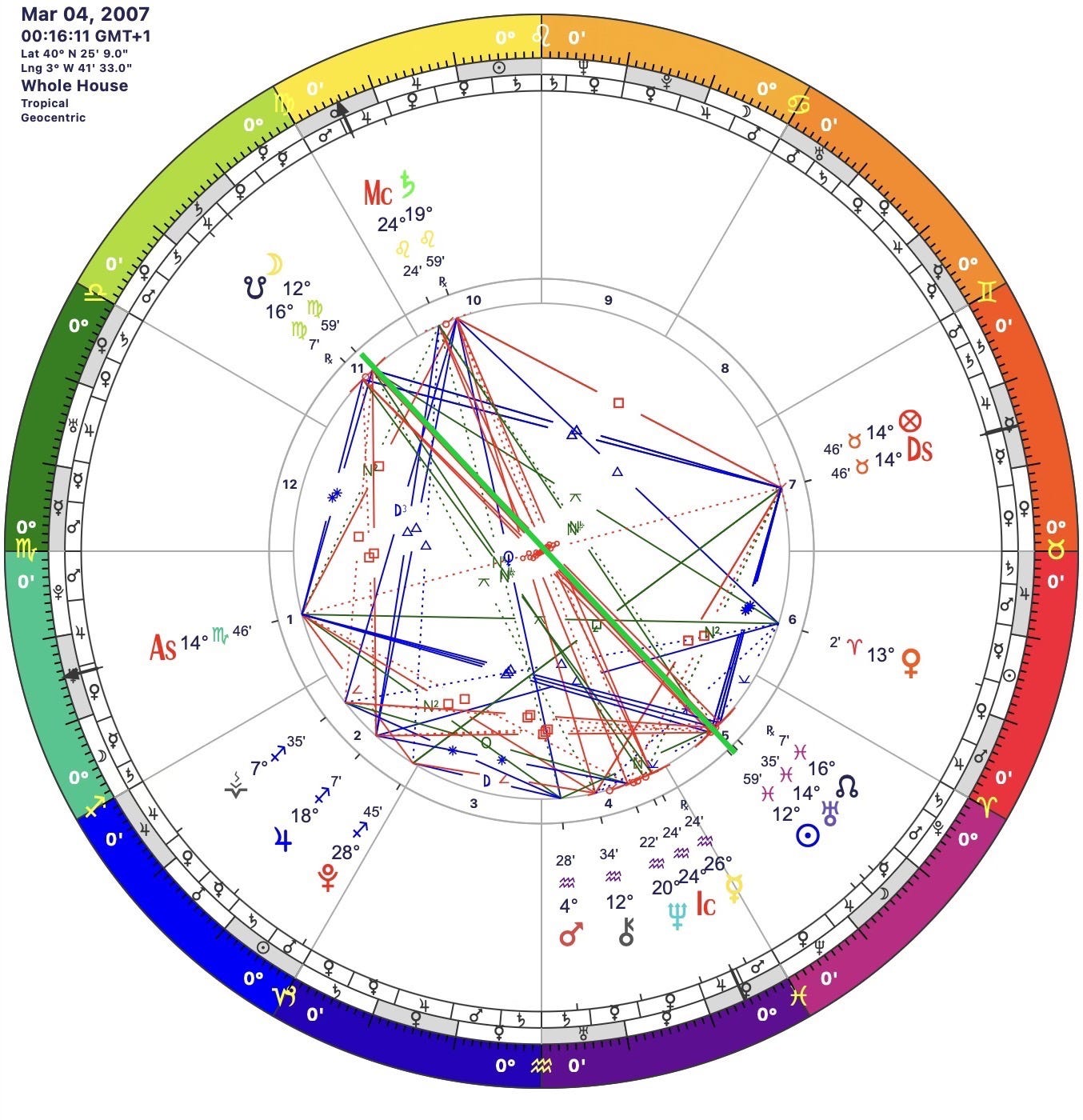
The symbolism returns, though not identically. In 2007, the eclipse squared Jupiter, and Mercury was retrograde then as well. Now, Jupiter sextiles the eclipse—offering opportunity—and trines the Sun, while Mercury is retrograde once though in Pisces, the most poetic, feeling-oriented, and projection-prone of signs. Here, thoughts and feelings cannot be sorted into neat categories. Instead, turn inward and pay attention to what your body is communicating. Virgo rules the small intestine, the processes through which we organize the details of life—and the places and states where we can cling too tightly. Know that this eclipse is reorienting you toward greater adaptability and teaching you how to move with the current of life.
If you go back even further to 2007. What was stirring then around work, health, systems, identity, relationships, usefulness, exhaustion, devotion, criticism, service, or the need to purify your life? Go back further, and we arrive at March 3, 1988—another Virgo lunar eclipse, sounding nearly the same note, close to the same degree.
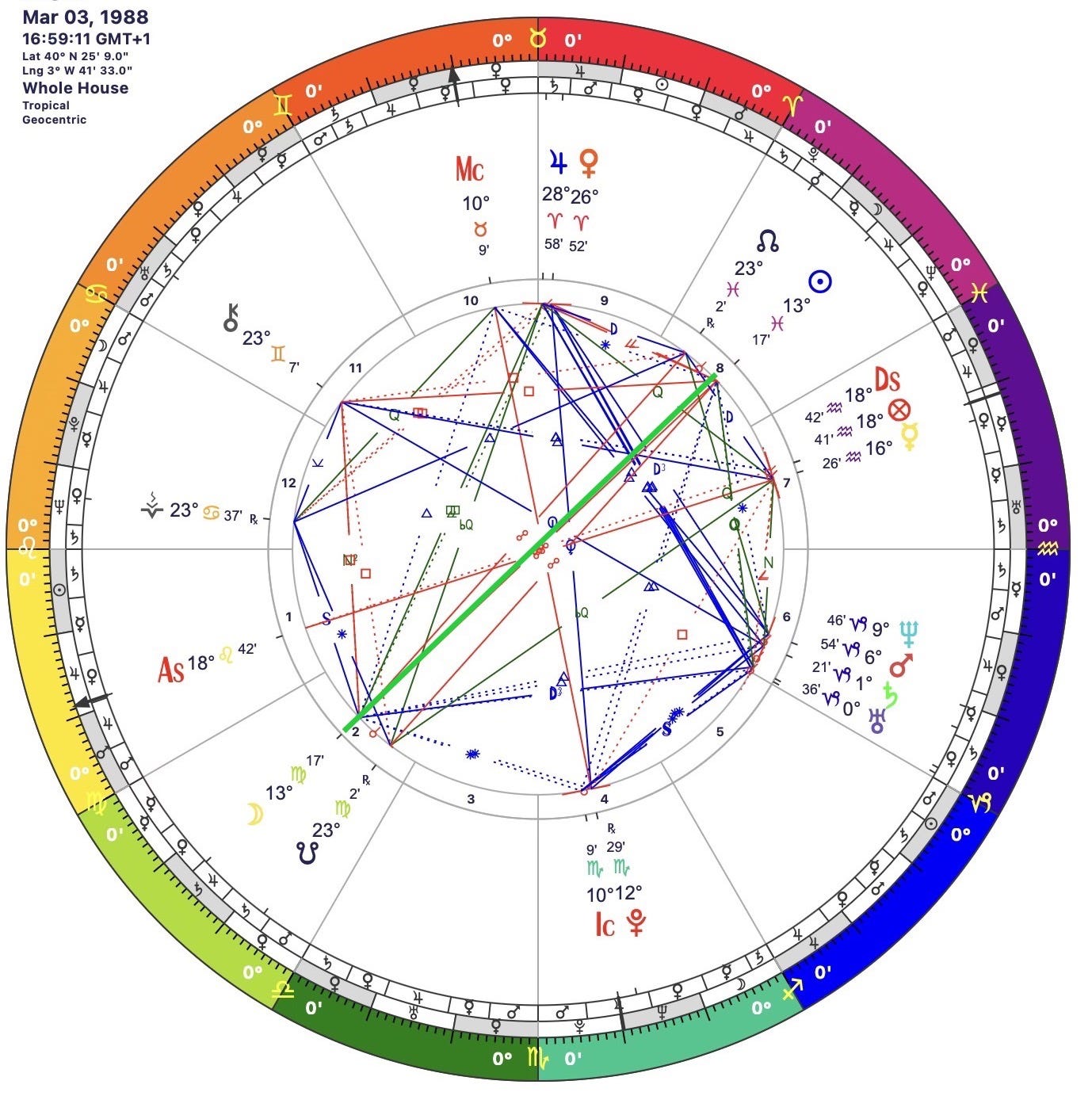
This is how eclipse memory works, and why eclipses are such a big deal: they are like folds in time, where a previous chapter casts its shadow forward. A latent storyline returns, asking to be met in a new octave each time. Astrology has never been a belief system (with the exception of the Vedas). It is a language of cycles, correspondences, and mathematical recurrence, and if you observe and study it, that becomes glaringly obvious.
This does not mean eclipses are curses. To categorize everything as “good” or “evil” is to animate a false polarity and ignore the deeper origin of oneness.
They are concentrated turning points. I often call them chiropractic adjustments: sudden cosmic realignments that occur when tension can no longer hold and a reckoning must take place.
This is why there is an old rule of thumb around eclipses: create spaciousness. Let nature course-correct. An eclipse is not the moment to impose your will, force an agenda, or cling to a storyline that has already exhausted its life. These cycles tend to return around every 9 years, and again across the broader 18- to 19-year rhythm, so what surfaces now is rarely random. It is a return, a correction, and a reordering. You can see this in the world, too: imposed wills replaying the same patterns, perpetuating the same conflicts, and extending cycles that were already asking to end.
The ancients were right to respect them.
As an astrologer, the priority is to hold both: reverence for the omen, and intelligence around the pattern.
Personally, this Virgo lunar eclipse can coincide with an ending, a completion, a correction, a release, a truth coming into focus, a habit breaking, a role dissolving, a health issue demanding attention, a work pattern reaching its limit, a relationship dynamic becoming legible through what it requires of your nervous system. Virgo brings the result of what has been repeated, but can only be remedied through release. A lunar eclipse brings the emotional visibility you can no longer avoid.
So pay attention to what is culminating.
What are you done carrying?
What have you perfected past the point of vitality?
Where has self-criticism replaced listening?
What system in your life once protected you, but now diminishes you?
Where are you being asked for cleaner devotion, not harsher control?
This is where Jupiter in Cancer matters and is supporting this eclipse.
There is support here for emotional honesty that nourishes—for choosing what protects life, leading with through care, and for recognizing that devotion can be an act of love. Not all endings need to arrive as abrupt volatility; some come as closure that makes way for a new beginning. A quiet knowing, and a rearrangement so obvious you wonder why you resisted it, except that is wasn’t time, until now.
That is the deeper wisdom of eclipse season.
The ancient Egyptians understood that an interruption in the sky could correspond to an interruption on earth. They were not naive, they read the eclipses as omens. They lived closer to the symbols of the sky, the seasons, and the language of omen than modernity does. Today, we speak differently. We speak in cycles, degrees, nodes, Saros families, nervous systems, embodiment, the economy, trends, AI, and collective timelines. The language has changed. The phenomenon has not.
When the Moon is eclipsed by Earth’s shadow, the story changes.
As a Virgo Full Moon lunar eclipse, this change begins with what has already ripened: what is ready to be seen, gathered, and brought into clear view as the light shifts.
Let this eclipse show you what in your life is ready to release through awareness, humility, and deeper alignment. Not every omen is meant to frighten you. Even in times of collective intensity and visible disorder, some clarify, realign, and restore precision to your path.
